Tags

Most of my life, I’ve associated Art with special occasions (e.g., going to MOMA). Thinking about or creating it daily would be out of whack–i.e., making it less special.
–MGM
 Visit Michael's Art Photography Portfolio at SaatchiArt.com! |

19 Thursday Jun 2014
Posted in Commentary
≈ Comments Off on Art as Special Occasion
Tags
Most of my life, I’ve associated Art with special occasions (e.g., going to MOMA). Thinking about or creating it daily would be out of whack–i.e., making it less special.
–MGM
|
Visit Michael's Art Photography Portfolio at SaatchiArt.com! |
19 Thursday Jun 2014
Posted in Commentary
≈ Comments Off on Photography Primarily Communication
Tags
For some reason, I find it more satisfying to think of photography as a means for trying to communicate something versus as a way to ‘make art‘.
–MGM
|
Visit Michael's Art Photography Portfolio at SaatchiArt.com! |
23 Friday May 2014
Posted in Announcements, MGM's Photos, Prints, Shoutouts
≈ Comments Off on My New Saatchi Art Gallery Portfolio
I have partnered with the Saatchi Art Gallery based in Los Angeles, California to sell art prints (on photo paper, fine art paper, and canvas) featuring a selection of my photographs. Please check it out!

Preview of My Saatchi Art Portfolio
|
Visit Michael's Art Photography Portfolio at SaatchiArt.com! |
12 Thursday Dec 2013
Posted in Announcements, Fashion/Glamour, MGM's Photos, Nudes, Shoutouts, Street
≈ Comments Off on MichaelGraceMartin.com gets New Home Page
Tags
It’s been a long time coming, but I’ve finally put up a new home page for michaelgracemartin.com!
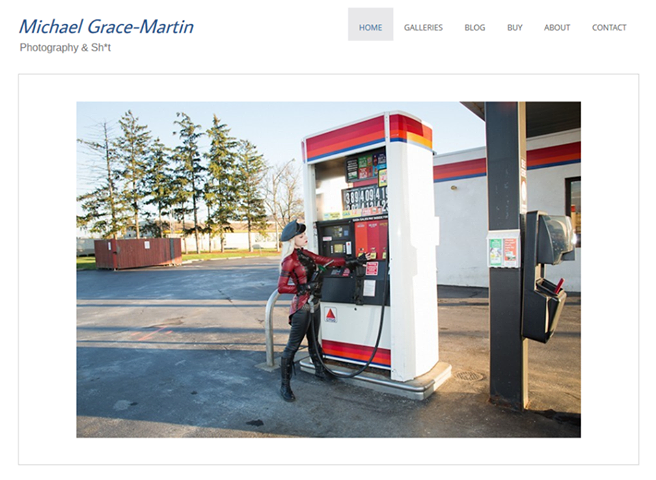
New MichaelGraceMartin.com Home Page
The idea was to put a more portfolio-oriented front end on my website to showcase (and possibly sell) my photographic work in a way that makes it easier to share with galleries, publishers, collectors, and others in a manner they’re used to and expect.
The photos I selected were the result of an initial pass through my recent work. These will be changing, evolving and growing over the next few weeks and months.
So take a look and come back every so often to see what I’ve been up to! I’ll be sure to mention major updates here on my blog…:-).
|
Visit Michael's Art Photography Portfolio at SaatchiArt.com! |
05 Thursday Dec 2013
Posted in Writing
≈ Comments Off on Transience of Elevation
Tags

Abstract Driving (Jan 2011)
In most cases, an artist cannot give but a transient experience of sensory or cognitive elevation. The opportunity lies in the initial moment/exposure; then it is gone.
|
Visit Michael's Art Photography Portfolio at SaatchiArt.com! |
07 Thursday Nov 2013
Posted in Commentary, MGM's Photos, Street
≈ Comments Off on Current Deadpan Fine Art Photography
Tags
This is a photo I snapped while on vacation last August (2013) in Michigan.

Boyne Falls, Michigan (Aug 2013)
(click image to see it larger..)
It struck me (while looking through my images from the trip) that this one fits–particularly well–a current deadpan aesthetic in fine art photography. Not much is going on (there can’t be much going on) and the colors go well together but can’t be too saturated (the red here is probably a tiny bit too strong), and there’s a fair amount of “balance” to the layout or composition.
In short, the image needs to be fairly “boring” so as to (presumably) engage the higher, more sensitive areas of the cerebral cortex without engaging too much sensory perception or emotional response which could hinder lofty cognitive processing.
I’m not totally “down” on such images (I take them myself sometimes), but I’m getting a little sick of them and find them kind of gutless.
I don’t think that staying away from any strong sensory or emotional response is the solution to getting people (viewers) to experience the sublime or (at least) something elevated above everyday experience.
To me this type of art photography is like a nice soothing break one takes between engagements with really interesting art photography…:p.
|
Visit Michael's Art Photography Portfolio at SaatchiArt.com! |
30 Wednesday Oct 2013
Posted in Commentary
≈ Comments Off on Photography as Emulation versus Creative Exploration
Tags
Sometimes you miss something because it’s too obvious.
Maybe most photographers think that emulating past photography is what ‘doing photography’ is
Not everyone cares about innovation or thinks that producing works or performances like those in the past is a bad thing. In fact, if they can approximate the work of their heroes/idols, they consider that a damn good accomplishment.
There’s nothing inherently bad about such a goal; it can be lucrative. In fact, some artists have actually done better than their predecessors (commercially and/or in terms of fame) by basically copying and extending somewhat work that influenced them and which they liked.
It’s not what I want to do however.
I want to discover something different using photography as one of my tools; I don’t even care if it ends up being a combination of photography with something else (e.g., words, drawings, audio, animation, whatever). Seeking out something new to me is what drives my creative endeavors.
Emulation isn’t evil or bad and, in fact, I find myself doing it on occasion and actually having fun with it. It can be a good touchstone and launching point.
Whether you want to go any further into uncharted territory is an individual “thang” and probably just depends on your personality…:-).
|
Visit Michael's Art Photography Portfolio at SaatchiArt.com! |
10 Thursday Oct 2013
Tags
art, nude, photograph, woman

Window Chair (August 2013)
Click image to see against dark background..
|
Visit Michael's Art Photography Portfolio at SaatchiArt.com! |
Posted by mgm | Filed under MGM's Photos, Nudes
≈ Comments Off on Window Chair (August 2013)
02 Wednesday Oct 2013
Tags
art, female, nude, photography, woman

Ella at the Window (August 2013)
Click image to see with dark background..
|
Visit Michael's Art Photography Portfolio at SaatchiArt.com! |
Posted by mgm | Filed under MGM's Photos, Nudes
≈ Comments Off on Ella at the Window (August 2013)
20 Friday Sep 2013
Posted in Commentary
≈ Comments Off on Role of Context and Tangibility in Art Appreciation
Tags
One aspect of art appreciation that I think may be quite important is Context: the context in which you are viewing a work of art.
The Internet has made works of art (especially two-dimensional art) accessible to millions of people on their computers and other digital devices they typically own. Much art viewing is happening in this electronically mediated context.
So the viewing context is the computer or device screen/s that people use to view art, and also: websites, email, weather reports, word processing documents, cell phone snapshots, etcetera. A computer or digital device is a general viewing (and listening) platform for the communication of digital information; it is not specialized for viewing art. So the art gets “mixed in” with all the other digital information perused on one’s computer and/or digital device.
Compare this experience of viewing art with seeing it at a gallery or art museum where the environment affects and becomes part of one’s perceptual and emotional experience of the art. Even a coffee table book brings more “context” (e.g., the cover: its design, material and texture) to the viewing of visual art than does a computer or other electronic device. Sure, a website can provide some design surrounding the display of the artwork; but in most cases, backgrounds are best kept neutral or plain white or black so as not to take away from the appreciation of the artwork; this doesn’t leave much “context” except for the viewing device itself.
Related to the context (and somewhat bound up with it) is the tangibility of the artwork. The physicality of the artwork too affects one’s experience of it.
On one end of the spectrum is an ephemeral, slightly flickering (e.g., at 60 Hz or whatever…fast enough so you don’t consciously notice) digital image that goes away when you turn off your computer or electronic device. Sure, you can bring it back onto your screen when you click the power switch back on; but it’s clearly not a permanent physical element in your environment.
Contrast this with a 4 ft X 6 ft framed photo or painting on a wall that you can get up close to and see the details of the brush strokes or paper texture, the sheen off the print/glass/frame, the depth of the frame and its texture, its distance from the wall, its weight (if you have the opportunity to touch or hold it), and so forth. This object has a true (possibly commanding) physical presence and will decay and interact with its surrounding environment like any other physical object. This is an artifact, not just a momentary pattern of pixels.
Now, it seems likely that good and/or inspiring art is likely to show through regardless of the viewing context–whether on a PC monitor or at MoMA. However, I think few would argue that the environment in which artwork is viewed or the physical qualities of the artwork itself has no impact on the viewer’s psychological or emotional response to the artwork. Making a trip to an art gallery or museum is a clear signal to one’s senses that something special is happening–that you are somewhere other than home or work or on your commute–where a less than everyday experience is a possibility and should be prepared for and expected. The same with opening a beautiful new coffee table book that contains engaging printed images.
A human being’s intellect and finer sensibilities are not totally removed from their physical nature. People respond most (best?) to art that is also physically present. Maybe its a feeling of kindredness, I don’t know; but people seem to feel closer to something that shares their physical nature–maybe because it more fully engages their senses?
The importance of context similarly points to the relevance of multiple dimensions or sensory inputs regarding a human being’s experience of art: artwork is not experienced in a sensory vacuum, and whatever “surrounds” the artwork is inevitably part of one’s experience of it.
So, have art galleries and museums and physical prints and paintings lost their value and soon, all two-dimensional art will be viewed primarily on digital devices?
I think it would be pretty tragic because I suspect the value of art itself in peoples’ lives would decline and an important source of inspiration and enlightenment would be lost from peoples’ lives…and they may not come to realize it until the availability of physical art dwindles to the point of being hard to find.
|
Visit Michael's Art Photography Portfolio at SaatchiArt.com! |